


blog

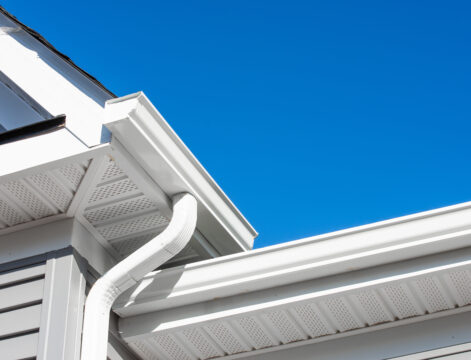
Your gutters do more than just catch rain and melting snow; they play a key role in protecting your foundation, siding and landscaping from water damage. This means that choosing the right gutter system matters. At Berg Home Improvements, we’ve been helping Chicagoland homeowners make smart home exterior decisions for over 50 years, and the seamless vs. sectional gutter question comes up often.
Here’s a clear breakdown of both of these systems.
How Do Seamless and Sectional Gutters Differ?
The biggest differences between seamless and sectional gutters have to do with the manufacturing process and their appearance. Seamless gutters are custom-fabricated on-site from a single, continuous piece of aluminum or other material. They are cut to match the exact dimensions of your home, which means there are no joints or seams along the length of the gutter run. The only seams are at the corners and where the downspouts connect.
Sectional gutters, on the other hand, are pre-cut at the factory into standard lengths. These sections are then joined together on-site using connectors and sealant. This has been a standard practice for gutters for many decades.
How Do Gutter Seams Affect the Risk of Leaks?
Seams are the weakness in any gutter system. Every connector joint is a potential entry point for water, especially as sealant ages, expands and contracts through seasonal temperature changes.
Seamless gutters help eliminate this risk along the entire run of the gutter. Because the material is custom-formed as one continuous piece, water has far fewer places to escape. Sectional systems, by contrast, rely on sealant at every joint, even along straight rooflines. Over time, those seals break down and may produce leaks.
Which Gutter System Is More Durable?
Both systems are commonly made from aluminum, though steel, copper and vinyl are also options. The key durability difference, therefore, comes down to the joints.
- Seamless gutters are generally less prone to sagging, warping and separation because there are no joints to pull apart.
- Sectional gutters are more vulnerable to joint failure, especially in climates with harsh winters and freeze-thaw cycles—something Chicagoland homeowners know well.
Thus, seamless gutters generally last longer with proper upkeep, simply because there are fewer failure points.
What Does Installation Look Like for Sectional and Seamless Gutters?
The installation process can vary quite a bit between these two types of gutters. For seamless gutters, a contractor brings a gutter-forming machine to your home and fabricates the gutters on-site to fit your rooflines. Installation is generally faster in terms of prep time and results in a clean, custom fit. Professional installation is required.
For sectional gutters, the sections are cut to fit your roof and snapped or screwed together, then sealed at each joint. Some homeowners opt to install sectional systems themselves, which can help lower upfront costs.
What Are the Long-Term Maintenance Differences?
Both systems require regular cleaning to prevent clogs and overflow. The maintenance gap between these two also comes down to the presence of seams in sectional gutters, as they have the additional maintenance need of regular joint resealing. Sectional joints may also trap debris more easily, increasing clog risk.
Homeowners who want a lower-maintenance system over the long run often benefit from choosing seamless gutters. However, it is worth noting that a damaged sectional gutter can be more easily replaced than a seamless gutter if needed. One section at a time can be replaced in a sectional gutter, while a seamless gutter system will need to be entirely replaced if damage occurs.
The Right Gutter System Starts With the Right Team
Both gutter types are designed to protect your home effectively when installed and maintained correctly. Seamless gutters typically offer an advantage in leak prevention and long-term durability, though, as sectional gutters may be more prone to leaks at joints and can demand more attention over time.
At Berg Home Improvements, we’ve helped numerous homeowners across the Chicagoland area install gutter systems that actually work for their homes. Want some help considering your options? Contact our team today for a free estimate.
Please call us to discuss your upcoming projects.
Recent Posts



Contact us
Please fill out form below to inquire about our services.